

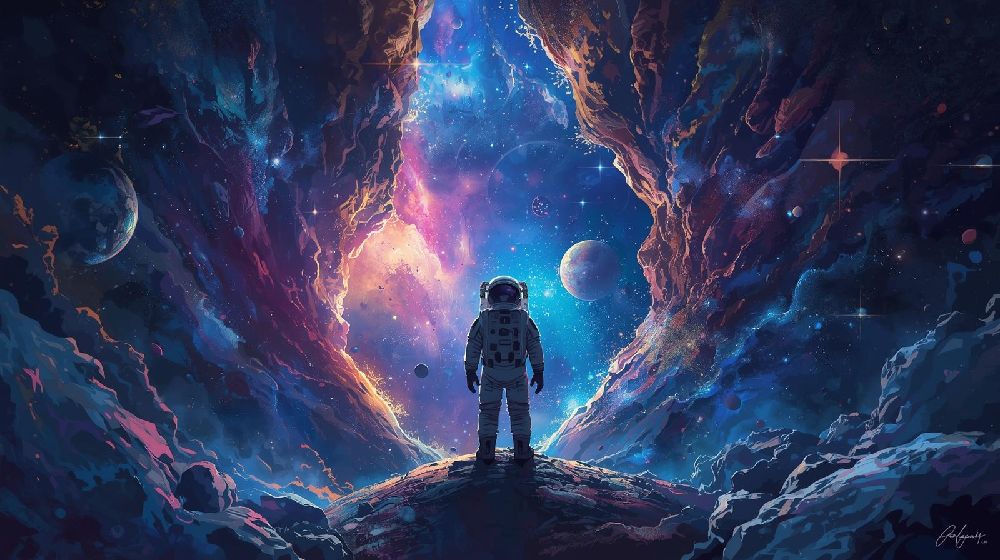
For centuries, humanity has looked at the stars and wondered whether our universe is unique—or just one of many. Modern physics and cosmology have brought a fascinating possibility into focus: the multiverse. This theory suggests that our universe might be part of an expansive, possibly infinite, collection of universes, each with its own laws of physics, dimensions, and realities.
What Is the Multiverse?
The term “multiverse” refers to the idea that multiple universes exist simultaneously, though most remain undetectable from our own. These universes could be vastly different from ours—or subtly alternate versions of reality. Scientists have proposed several types of multiverses:
Bubble Universes: Cosmic inflation theory suggests that our universe is one “bubble” among countless others, each expanding in its own space-time.
Parallel Worlds: Quantum mechanics implies that every possible outcome of a decision could create a branching universe—a realm where alternative histories unfold.
Higher-Dimensional Universes: Some string theories suggest that additional dimensions may host entirely separate universes beyond our perception.
Why Scientists Consider the Multiverse Possible
The multiverse theory isn’t just science fiction—it arises from real physics:
Cosmic Inflation: Moments after the Big Bang, the universe expanded exponentially. Inflationary models suggest this process could generate countless bubble universes.
Quantum Mechanics: The famous Schrödinger’s cat thought experiment hints that multiple realities can exist simultaneously at a quantum level.
String Theory: The mathematics of string theory predicts a “landscape” of solutions, each corresponding to a universe with different physical constants.
While direct evidence is lacking, these models offer mathematically consistent ways to explain phenomena like dark energy, fine-tuning of physical constants, and cosmic coincidences.
Implications of a Multiverse
If the multiverse exists, it could redefine our understanding of reality and humanity’s place in it:
Cosmology: Many “coincidences” in our universe, like the precise balance of physical constants that allow life, could simply be a result of selection bias across countless universes.
Philosophy: Questions about free will, destiny, and existential meaning gain new dimensions when alternate realities are considered.
Science & Technology: Concepts like faster-than-light travel, wormholes, or quantum communication might find new interpretations in a multiverse framework.
Challenges in Proving the Multiverse
Despite its theoretical appeal, testing the multiverse remains extremely difficult:
Observable Limits: By definition, other universes may exist beyond our cosmic horizon, making them fundamentally unobservable.
Experimental Constraints: While indirect evidence—such as cosmic microwave background anomalies—offers hints, definitive proof is elusive.
Philosophical Debate: Some critics argue that unverifiable universes may fall outside the realm of empirical science.
Yet, researchers continue to explore creative methods, from analyzing cosmic background radiation to quantum simulations, hoping to catch glimpses of parallel realities.
The Multiverse in Popular Culture
The idea of multiple universes has inspired countless novels, movies, and TV series. From superhero crossovers to alternate history tales, the multiverse captures imagination, making abstract physics both entertaining and relatable. These stories encourage us to ask: What if reality is far more expansive than we can ever perceive?
Conclusion
The multiverse is one of the most mind-expanding concepts in modern science. It challenges our understanding of space, time, and existence itself. While we may not yet have proof, exploring the possibility reminds us how much remains unknown—and how curiosity and imagination are essential tools for unraveling the universe’s deepest mysteries.
Whether a single universe or an infinite tapestry of worlds, the quest to understand our cosmic home continues—and the journey is as thrilling as the destination.