

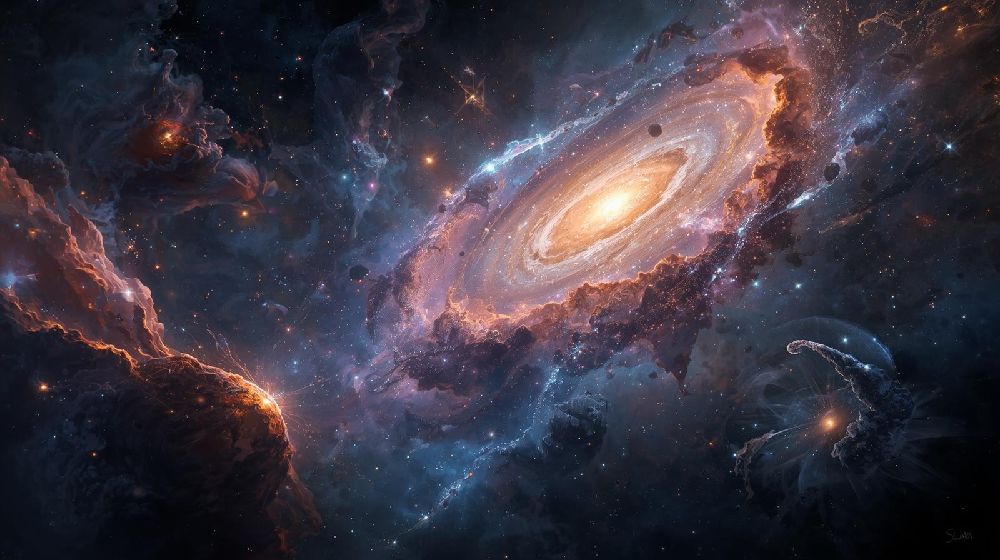
The universe as we see it today—a vast expanse of galaxies, stars, planets, and cosmic voids—did not always look this way. Its large-scale structure, from sprawling galaxy clusters to intricate filaments of dark matter, has roots in the tiny quantum fluctuations that occurred in the universe’s earliest moments. Understanding these fluctuations gives us insight into how order emerged from the primordial chaos.
What Are Quantum Fluctuations?
Quantum fluctuations are temporary changes in energy at extremely small scales, arising from the principles of quantum mechanics. In the microscopic world, particles constantly appear and vanish, and energy levels shift spontaneously, even in seemingly “empty” space.
Though minuscule, these fluctuations are fundamental to nature—they are the seeds of all structure in the universe.
From the Quantum to the Cosmic
In the very early universe, a fraction of a second after the Big Bang, space underwent rapid inflation, expanding exponentially in a tiny fraction of a second. During this inflationary period, the tiny quantum fluctuations were stretched to macroscopic scales.
This process caused regions of space to have slightly different densities. Over billions of years, gravity amplified these differences, leading to:
Dense regions forming galaxies and clusters
Sparse regions forming cosmic voids
Filamentary structures that weave the cosmic web
In essence, the vast cosmic structure we observe today originated from the quantum jitters of the early universe.
Observational Evidence
Cosmic Microwave Background (CMB) radiation provides a snapshot of the universe about 380,000 years after the Big Bang. Tiny temperature variations in the CMB correspond directly to the density fluctuations seeded by quantum processes.
Satellites like COBE, WMAP, and Planck have mapped these variations with incredible precision, confirming that quantum fluctuations are the blueprint for cosmic structure.
Why It Matters
Understanding the role of quantum fluctuations bridges the worlds of quantum physics and cosmology. It reveals that:
Small-scale quantum effects can shape the largest structures in existence
The universe’s structure is deeply connected to the laws of fundamental physics
Observing cosmic structures allows scientists to test models of the early universe and inflation
In short, studying these tiny fluctuations helps answer some of humanity’s biggest questions: Why does the universe look the way it does? How did galaxies form? What governs cosmic evolution?
The Mystery Continues
While much has been learned, questions remain. Scientists are still exploring:
The exact mechanisms of inflation
How quantum fluctuations interact with dark matter and dark energy
Whether there are hints of multiverse structures born from quantum processes
Each discovery brings us closer to understanding the cosmic blueprint written in the quantum realm.
Conclusion
Quantum fluctuations—tiny, fleeting changes in energy—may seem insignificant, but they shaped the universe’s grandest structures. From subatomic jitter to the magnificent cosmic web, the story of the cosmos is a testament to the profound connection between the smallest scales and the largest expanses.
By studying these fluctuations, we glimpse the universe’s origin story and the delicate quantum dance that gave birth to everything we see in the night sky.