

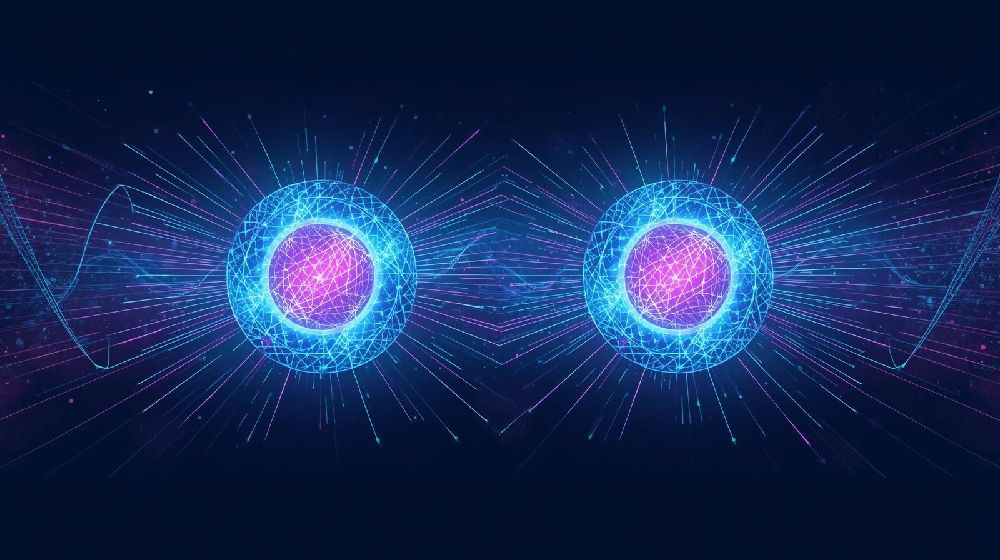
Quantum entanglement is one of the most fascinating—and often confusing—concepts in modern physics. It sounds like science fiction: particles separated by vast distances can remain mysteriously connected, instantly influencing each other. Yet, this phenomenon is real, experimentally verified, and is paving the way for revolutionary technologies like quantum computing and secure communication. Let’s break it down in simple terms.
What Is Quantum Entanglement?
At its core, quantum entanglement occurs when two or more particles become linked in such a way that the state of one particle is directly related to the state of the other, no matter how far apart they are.
Imagine a pair of magic dice. If you roll one dice on Earth and it shows a six, the other dice on Mars would instantly show the same result—without anyone touching it. While this is a simplified analogy, it captures the essence: entangled particles share a connection that transcends distance.
How Do Particles Become Entangled?
Particles can become entangled through certain interactions, like:
Splitting a single particle into two
Photons interacting in a controlled experiment
Carefully manipulating atoms in a lab
Once entangled, the particles’ properties—like spin, polarization, or energy—become interdependent. Measuring one particle immediately affects the state of the other, even if they are light-years apart.
Why Scientists Are Excited About Entanglement
Quantum Computing
Entangled particles can process and store information in ways that classical computers cannot. This could lead to incredibly fast problem-solving in cryptography, medicine, and climate modeling.Quantum Cryptography
Entanglement enables ultra-secure communication, where any attempt to eavesdrop on a message immediately changes the state of the particles, revealing intrusion.Fundamental Physics Research
Studying entanglement helps scientists understand the fundamental nature of reality, including questions about space, time, and the limits of causality.
Misconceptions About Entanglement
No faster-than-light communication: While entangled particles influence each other instantaneously, this cannot be used to send messages faster than light.
Not magic: Entanglement follows precise quantum mechanical rules that can be measured and predicted.
Why It Matters to Everyone
Quantum entanglement may seem abstract, but its impact is practical and far-reaching:
Faster and more powerful computing for daily technology
Safer online transactions and communication
Advancements in medicine, energy, and materials science
Even if you’re not a physicist, entanglement represents the cutting edge of human understanding and innovation.
Conclusion
Quantum entanglement shows us that the universe is far stranger and more interconnected than we imagine. By linking particles across space instantly, it challenges our notions of distance and reality. As research continues, entanglement promises to reshape technology, security, and science itself, proving that some of the most complex concepts can also have the most profound practical applications.