

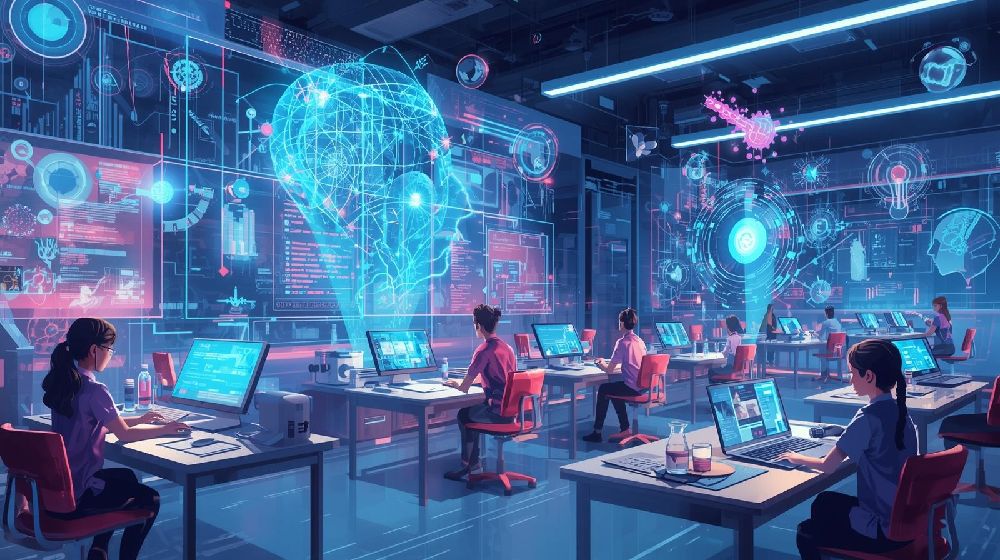
Science education is undergoing one of the biggest transformations in history. Traditional teaching—once limited to textbooks, chalkboards, and physical labs—has evolved into a dynamic, digital-first experience. Today, digital labs and artificial intelligence (AI) are reshaping the way students learn, experiment, and understand scientific concepts.
This revolution is not just enhancing education; it’s making science more accessible, interactive, and future-ready.
1. What Are Digital Labs?
Digital labs are virtual learning environments where students can perform scientific experiments using:
Simulations
3D models
Virtual instruments
Interactive environments
These labs mimic real-world scientific scenarios, allowing students to experiment without the limitations of physical resources.
Examples include virtual chemistry labs, physics simulators, and 3D biology models.
2. Why Digital Labs Are Transforming Science Learning
Hands-On Learning Without Limits
Students can perform experiments that might be too dangerous, expensive, or time-consuming in real life—like chemical reactions or space simulations.
Accessible Anytime, Anywhere
Digital labs can be accessed from classrooms, homes, or remote areas, ensuring continuous learning even without a physical science lab.
Cost-Effective
Schools save on expensive laboratory equipment, chemicals, and maintenance.
Instant Feedback
Students receive real-time feedback, allowing them to understand mistakes and correct them immediately.
3. The Role of AI in Modern Science Education
AI is transforming science learning in powerful ways:
Personalized Learning
AI analyzes each student’s strengths and weaknesses, offering customized lessons, quizzes, and suggestions.
Intelligent Virtual Tutors
AI-powered assistants explain concepts, solve doubts, and provide guidance just like a real tutor—available 24/7.
Predictive Analytics
AI predicts learning outcomes and identifies where students need more help, enabling teachers to intervene early.
Automated Assessments
AI grades quizzes, assignments, and lab reports instantly, saving teachers time and ensuring consistency.
4. How AI and Digital Labs Work Together
The combination of AI and digital lab technology creates a powerful, immersive learning ecosystem.
AI guides students through virtual experiments
Errors are highlighted instantly
Simulations adapt in real time based on student actions
Learning becomes interactive and self-paced
Together, they make science exciting, intuitive, and deeply engaging.
5. Benefits for Educators and Institutions
Better Classroom Engagement
Students are more motivated and curious when learning through simulations and AI-based tools.
Enhanced Teaching Efficiency
Teachers can track student progress, analyze performance trends, and focus on areas needing attention.
Bridging the Gap in Resource-Limited Schools
Even schools without sophisticated physical labs can provide world-class science education using digital labs.
6. Preparing Students for Future STEM Careers
With industries increasingly relying on:
biotechnology
robotics
space sciences
data science
AI engineering
nanotechnology
Digital labs introduce students to the tools and technologies they will use in real scientific careers.
This early exposure builds confidence, creativity, and innovation.
7. The Future of Science Education
The rise of AI and digital labs signals a shift toward:
Virtual reality (VR) science explorations
Augmented simulations
AI-generated scientific problem-solving
Collaborative cloud-based labs
Hyper-personalized learning journeys
Science education is no longer restricted to physical limits. The classroom of the future is digital, intelligent, and limitless.
Conclusion: A New Era of Learning
Digital labs and AI are not just enhancing science education—they are redefining it. They make learning more interactive, equitable, and aligned with the demands of the modern world.
By embracing these technologies, educators prepare students not only to understand science but to innovate, experiment, and lead the scientific discoveries of tomorrow.